 | Half your time should be for practicing skills like tone, technique and articulation.
The rest of the time is for music you are working on (solos, band or orchestra
pieces)
| Take notes at your lessons, bring a tape player and record your lessons.

 | Be creative
| Analyze the problem areas of your playing
| How many ways can you invent to help solve the problems in your playing?
| 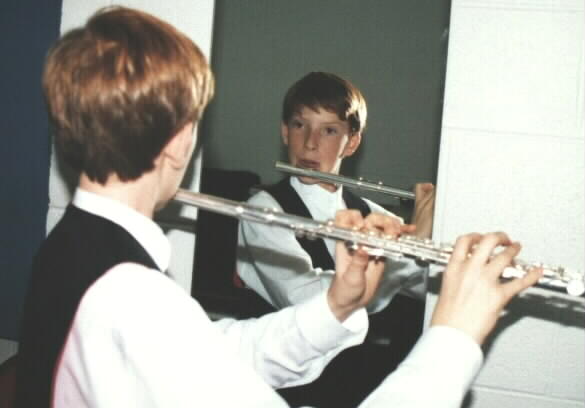 Use a mirror. If you can see what
you are doing, chances are you can fix any problems you identify. Use a mirror. If you can see what
you are doing, chances are you can fix any problems you identify.
| Break things down into bite size pieces
 | If you are having problems learning a lot of black notes, work on them one group at a
time. Gradually put them together in longer and longer sections until you can play
the whole passage.
| Frustration results when you try to do too much too fast.
| Believe it or not, for quick results, work slowly and carefully.
| Set realistic goals
| Get to know your strengths and weaknesses
| Keep a notebook of how you plan to organize your practice time and goals you want to
accomplish.
| Seek out opportunities to increase your knowledge of flute playing (private lessons,
summer flute camps, master classes, clinics)
| Look for ways to challenge yourself to become a better player.
| Solo competitions
| Orchestra
| Band
| Chamber music (duets, trios, quartets, quintets)
| Flute choir
Do the work
| If you don't practice, you won't improve
| Having a good flute is important but you still must practice
| Find an experienced private flute teacher with at least one college degree in flute
performance.
| Enjoy practicing! If you don't like it, you shouldn't be doing it. Find
something else you do like doing.
Dr. Cate Hummel.
Copyright � 1999 The Flute Line. All rights reserved.
Last revised:
June 23, 2016
| | | | | | | | | | | | | | | | | | | | | | | | 
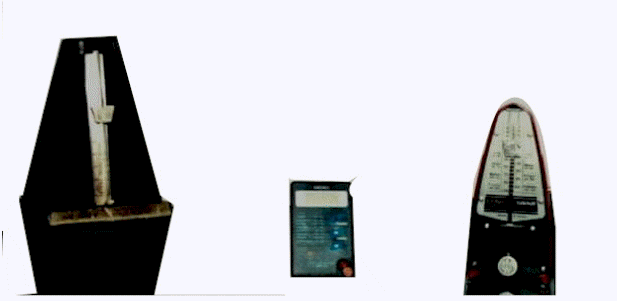 Use a metronome
(get one loud enough to hear clearly when you play)
Use a metronome
(get one loud enough to hear clearly when you play)